Pages

Showing posts with label internet. Show all posts

Monday, September 13, 2010

Year 7: "Hands up how many people read books"......

The new 'book'?

One of the fascinating comments I had today while teaching a new starter group in my school was after asking a question about the number of them that read books. The response, while admittedly, unsurprising was the fact that about 80% of them said they didn't read books at all. And of course, this was followed up by a comment from one of the kids that the only thing they read nowadays is on the Internet.


I have to say that I was kind of expecting this - I've read enough articles and books about the topic to be aware of it. And in many ways, I can see why books just don't have that incentive when they're competing against the likes of Facebook, the Internet in general, normal playtime, and computer games.

But the question whether kids stopping reading long-form text is a good thing or not. Personally, I know there's a lot to be said from reading such material - I wonder if there is even a subconscious training for focus that comes from reading. Internet-based reading is very short, only articles or links to posts that they see from friends.

do you think this is a good thing?

And how do we, as teachers, persuade pupils to read for actual enjoyment, and not only as required reading for work (that they probably receive through subjects such as English)?

Tuesday, May 25, 2010

Technology - the concept of 'trust' and 'privacy' online

The beginnings of rumblings of complaints have started to surface amongst the technology bloggers and tech writers worldwide. Even The Sunday Times had a massive article about it this weekend (and unfortunately due to their new subscription model on the website, I can't link to it). Other examples are Leo Laporte, the online broadcaster, and it's a sign of the times that even well known online leaders are taking the leap.
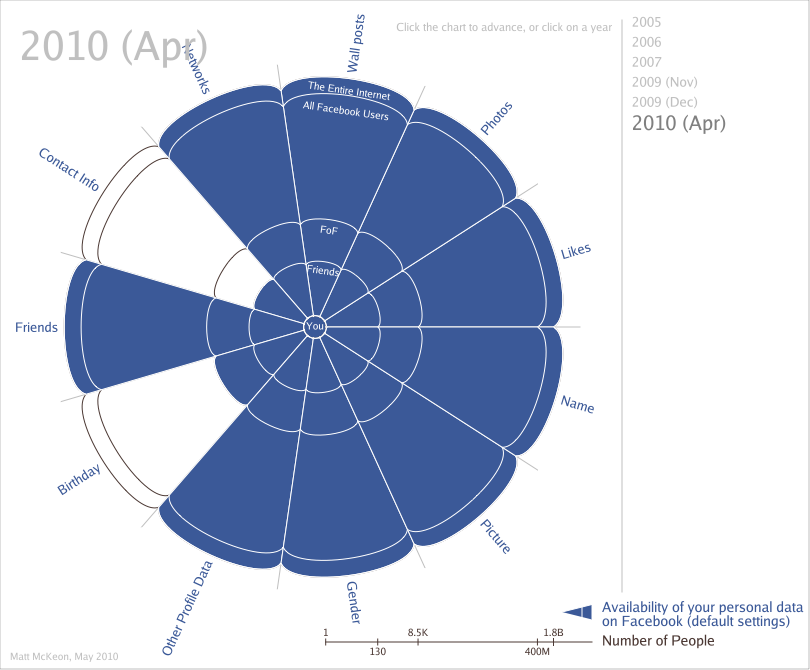
Honestly, it does feel a little bit hyped up in it's current context, in many ways nothing has really changed in the past few months. Yes, Facebook has slowly been changing and updating it's terms of use (up to almost 6,000 words I believe!), making it more elaborate and, most definitely, mind boggingly confusing. No one seems to understand it - but what is important is how Facebook is handling your data. I presume anyone who reads this blog will have seen this diagram (as linked from allfacebook.com):


All the sections in blue, are sections that Facebook has made public. By default. How ridiculous is that?!?!? But anyway, if you want more information on this whole issue, there's a lot more places online that will give a better and more professional opinion on it's current status. Suffice to say, it seems that we'll all be getting some new privacy settings this week after Facebook slowly tries to mop up the publicity mess it seems to have caused.

The thing is though, with all this discussion, it's roaming around all the concepts of privacy and how to behave online. Most people will probably have heard of someone (either local or through a newspaper article) who has been fired, quit, their job from a comment they made on a social networking site. As I said to @timbuckteeth on Twitter recently:


There's still a detachment between many people's perception of their online world and the 'real' world. Firstly, the 'real' world is now everything - i.e. your online persona is part of life. Look at how many Facebook accounts there are currently - over 400 MILLION. That's a serious number of people, and I could be wrong, but I think it's something like over 60% of those users who sign on every day.


Basically at present, we're slowly evolving to include these new facilities in our mindset. What we write online will come back to haunt us in the future, we just haven't realized it yet. I know I always make a point of when I comment on a forum/blog to use my real name and contact info - basically, some of it is to keep me honest. In doing so, I am always conscious of the fact that these comments could be said back to me in the future. Don't get me wrong, I've said some things over the years that I laugh at now, but they were just opinions - things I'd have said in person, it's just my perspective has changed. Having said, that the other side of the coin is that I just don't trust  comments that are made annonymously - I feel that by not providing a name dilutes the status of such responses as I have to consider that the person is just uncomfortable with this opinion and thus it might not be completely valid.


Of course, the other side of the coin is those who just aren't involved online. Is this because they're smart enough to recognize the potential dangers, or just because they don't see the relationship/benefits of this new communication medium? I'd love to know!

And then in relation to teaching and the younger generation, I wonder is there a different perception with younger people because they have always had these mediums around them, it's not like they're having to learn them after years of familiarity to just the telephone and text message to communicate. Are they just more aware of the potentials, or are they more naive (and just haven't thought about it)? I know I ask pupils nowadays whether they've used the Internet, and the traditional response is, "Sir, that's one of your dumb questions!" :)

Monday, April 19, 2010

What kind of tech user are you?


The Pew Internet and American Life Project (from the PewResearchCenter) are running an online survey to see 'what type of tech user are you?'.


I'm a Digital Collaborator -

If you are a Digital Collaborator, you use information technology to work with and share your creations with others. You are enthusiastic about how ICTs help you connect with others and confident in your ability to manage digital devices and information. For you, the digital commons can be a camp, a lab, or a theater group – places to gather with others to develop something new.
What are you? (direct link to survey)
I'd think personally that this is pretty accurate in it's description (And thankfully! I hate when I'm described as something I don't see myself as :). The Internet is a huge community, I'm just trying to make the most of it.
Thanks to @reportertanya (twitter) for the link!

Thursday, October 18, 2007

Internet duplication

Has anyone noticed the one small issue with the Internet (o.k., there's more and maybe it's not small :). I had an email discussion with a friend yesterday about the fact of duplicity.
you'll all have seen it. You do a search on Google (does anyone use anyone else anymore?!) and it comes back with 50,000 results for your query. you start trawling through some of the links to find that lots of them are basically 'copy and pastes' of other sites. Bad form, eh?

the main reason the discussion came about was due to posting up calendar events on TGU. I was lamenting the fact that I couldn't see why we were going to have to create our own Google Calendar entries for tv shows when I couldn't understand why the tv networks weren't offering it themselves. They're the sort of thing that would just be useful. These are the sort of things that fall across multiple areas though.
Why so many different CD lookup databases - would it not be easier to just have one single global one? Instead of having to looking across multiple databases to find album info, it would all be in one location.
I suppose Wikipedia has the potential to work like this - a central repository for all info regarding, well, everything (and taking the example, I see people have started adding all data related to music artists, including track listings - now all they have to do is integrate it into all the music players ;)

What do people think on this?

Thursday, August 16, 2007

The charging of internet services

The BBC took a very brave move this year and opened a new service to all UK-based internet users. Download their new iPlayer application and they have access to all shows that the Beeb show for up to a week after it's been broadcast on television. Ingenious and considering it's free, a big transformation for the use of the 'net. Up till now, finding tv shows through the 'net has involved some searching and messy use of BitTorrent clients (lifehacker has a posting here: http://feeds.gawker.com/~r/lifehacker/full/~3/140366990/a-beginners-guide-to-bittorrent-285489.php about how to do it).

But now, it seems that some of the ISP (Internet providers) in the UK are now demanding financial compensation (see Ars Technica article here: http://arstechnica.com/news.ars/post/20070813-isps-to-bbc-we-throttle-iplayer-unless-you-pay-up.html) from the BBC due to the potential higher demands on their networks! Oh oh...is this how the internet is going? In the long term what's going to happen here - does it mean that eventually in the long run the beginning of a so-called multiple level 'net (tiered internet as they're calling it) where there's some services that you can have access to, but you have to pay additional costs to access. That's like been told you can have water coming into your house, but you have to pay extra for it to be drink-able.......

I can appreciate that internet providers are having difficulties justifying upgrades to their network considering they're having difficulties getting cash out of consumers. At the end of the day, most consumers don't care about their 'net connection so long as it gives them webpages at decent speeds and it works. So they won't see that to provide video services over the internet involves faster connections for everyone. Considering they charge a paltry 40 Euro a month in Ireland (and you can get cheaper), I can only imagine it's not a big profit they're making

anyone in the tech field know anything more about this?